|
Layers
Diffusion in heterogeneous environments
|
Function for solving the forward problem with the 3-layer model. More...
#include <stdio.h>#include <stdlib.h>#include <string.h>#include <time.h>#include <math.h>#include "header.h"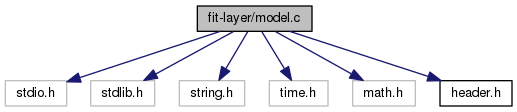
Go to the source code of this file.
Functions | |
| void | calc_diffusion_curve_layer_fit_layer (int nt, int nz, int nr, int iprobe, int jprobe, int iz1, int iz2, int nolayer, double dt, double dr, double sd, double st, double alpha_so, double theta_so, double kappa_so, double alpha_sp, double theta_sp, double kappa_sp, double alpha_sr, double theta_sr, double kappa_sr, double dfree, double *t, double *s, double *invr, double *p) |
| Calculates the concentration as a function of space and time and returns the probe concentration as a function of time. More... | |
Function for solving the forward problem with the 3-layer model.
Definition in file model.c.
| void calc_diffusion_curve_layer_fit_layer | ( | int | nt, |
| int | nz, | ||
| int | nr, | ||
| int | iprobe, | ||
| int | jprobe, | ||
| int | iz1, | ||
| int | iz2, | ||
| int | nolayer, | ||
| double | dt, | ||
| double | dr, | ||
| double | sd, | ||
| double | st, | ||
| double | alpha_so, | ||
| double | theta_so, | ||
| double | kappa_so, | ||
| double | alpha_sp, | ||
| double | theta_sp, | ||
| double | kappa_sp, | ||
| double | alpha_sr, | ||
| double | theta_sr, | ||
| double | kappa_sr, | ||
| double | dfree, | ||
| double * | t, | ||
| double * | s, | ||
| double * | invr, | ||
| double * | p | ||
| ) |
Calculates the concentration as a function of space and time and returns the probe concentration as a function of time.
This function solves the diffusion equation in each layer  ,
,
![\[ \frac{\partial c_k(\vec r, t)}{\partial t} = D_{free} \theta_k \nabla^2{c_k(\vec r, t)} + s/\alpha_k - \kappa_k c_k(\vec r, t) \quad , \]](form_37.png)
subject to the continuity conditions at the interfaces between layers
![\[ c(\vec r_k, t) = c(\vec r_{k+1}, t) \quad \]](form_38.png)
![\[ \alpha_k \theta_k \nabla c(\vec r_k, t) = \alpha_{k+1} \theta_{k+1} \nabla c(\vec r_{k+1}, t) \quad \]](form_39.png)
and the boundary condition  (total absorption) at the top, the bottom, and the side of the cylinder, where
 = concentration in layer
 = free diffusion coefficient
 = permeability in layer
 = source in layer
 = extracellular volume fraction in layer
 = nonspecific clearance factor in layer
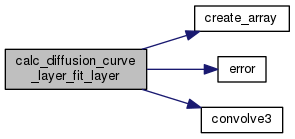
This function calls convolve3() to compute the Laplacian in cylindrical coordinates.
| [in] | nt | Number of support points in time |
| [in] | nz | Number of rows of concentration matrix |
| [in] | nr | Number of columns of concentration matrix |
| [in] | iprobe | z-index of probe location |
| [in] | jprobe | r-index of probe location |
| [in] | iz1 | z-index of SR-SP boundary |
| [in] | iz2 | z-index of SP-SO boundary |
| [in] | nolayer | Flag for whether to model a single homogeneous environment (true) or to model a 3-layer environment |
| [in] | dt | Spacing in time (  ) ) |
| [in] | dr | Spacing in r (in this program,  ) ) |
| [in] | sd | Source delay (time before source starts) |
| [in] | st | Duration of source |
| [in] | alpha_so | Extracellular volume fraction in SO layer |
| [in] | theta_so | Permeability in SO layer |
| [in] | kappa_so | Nonspecific clearance factor in SO layer |
| [in] | alpha_sp | Extracellular volume fraction in SP layer |
| [in] | theta_sp | Permeability in SP layer |
| [in] | kappa_sp | Nonspecific clearance factor in SP layer |
| [in] | alpha_sr | Extracellular volume fraction in SR layer |
| [in] | theta_sr | Permeability in SR layer |
| [in] | kappa_sr | Nonspecific clearance factor in SR layer |
| [in] | dfree | Free diffusion coefficient |
| [in] | t | Time array |
| [in] | s | Source array |
| [in] | invr | Array for  values values |
| [out] | p | Probe array (concentration as a function of time) |
Definition at line 94 of file model.c.

 1.8.11

